



Another Big Win For Gun Rights at the Supreme Court
By Selina Xia Zamacois
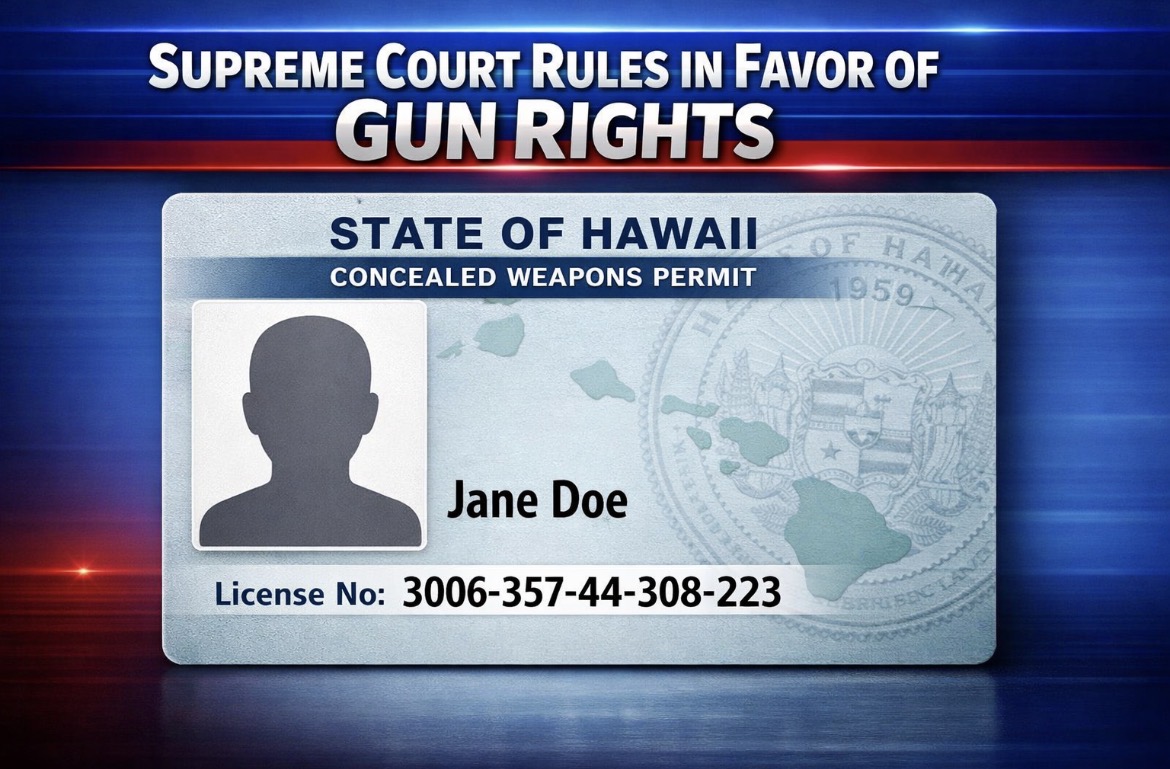
WASHINGTON, D.C. — The Supreme Court of The United States ruled that Hawaii’s sweeping restrictions on carrying firearms onto private property open to the public violate the Second Amendment, marking another major decision defining the scope of gun‑rights protections after District of Columbia v. Heller and New York State Rifle & Pistol Association v. Bruen.
The Wolford v. Lopez ( 24‑1046 case), centered on a Hawaii statute that made it a crime for licensed gun owners to carry a firearm onto any privately owned business or property open to the public—such as gas stations, restaurants, and retail stores—unless the owner gave express, affirmative consent.
Writing for the Court, the majority held that Hawaii’s law “flips the default rule at common law,” which historically allowed people to enter public‑facing private property unless the owner withdrew consent. The Court found no historical tradition supporting a blanket presumption against carrying firearms on such property.
The opinion emphasized that Hawaii’s rule imposed “severe restrictions” on residents who had already met the state’s rigorous requirements for obtaining a carry permit. Under the law, permit holders risked criminal liability simply by entering everyday locations without first securing explicit permission.
The Court applied the two‑step historical test outlined in Bruen, reaffirming that modern firearm regulations must be consistent with the nation’s historical tradition of firearm regulation. The majority concluded that Hawaii failed to identify any historical analogue that justified its broad prohibition.
The ruling reiterated that the Second Amendment’s “central concern” is the right of self‑defense, as recognized in Heller, and that states may not rely on “ahistorical interest‑balancing” to justify sweeping restrictions.
The decision invalidates Hawaii’s default‑ban approach and signals limits on how far states may go in restricting where licensed gun owners can carry firearms. While the Court acknowledged that certain sensitive‑place restrictions remain permissible, it held that Hawaii’s rule was far broader than historical precedent allows.
The ruling may affect similar laws in other states that attempted to restrict carry rights after Bruen by designating large categories of property as off‑limits.
Hawaii had long been one of the most restrictive states for public carry. After Bruen struck down New York’s “may‑issue” permitting scheme in 2022, Hawaii replaced its own system with new laws that, according to the Court, achieved “a similar result” by sharply limiting where permit holders could legally carry.
Petitioners Jason Wolford and others challenged the statute, arguing that it effectively nullified their right to carry outside the home. The Ninth Circuit upheld Hawaii’s law, but the Supreme Court reversed it.