



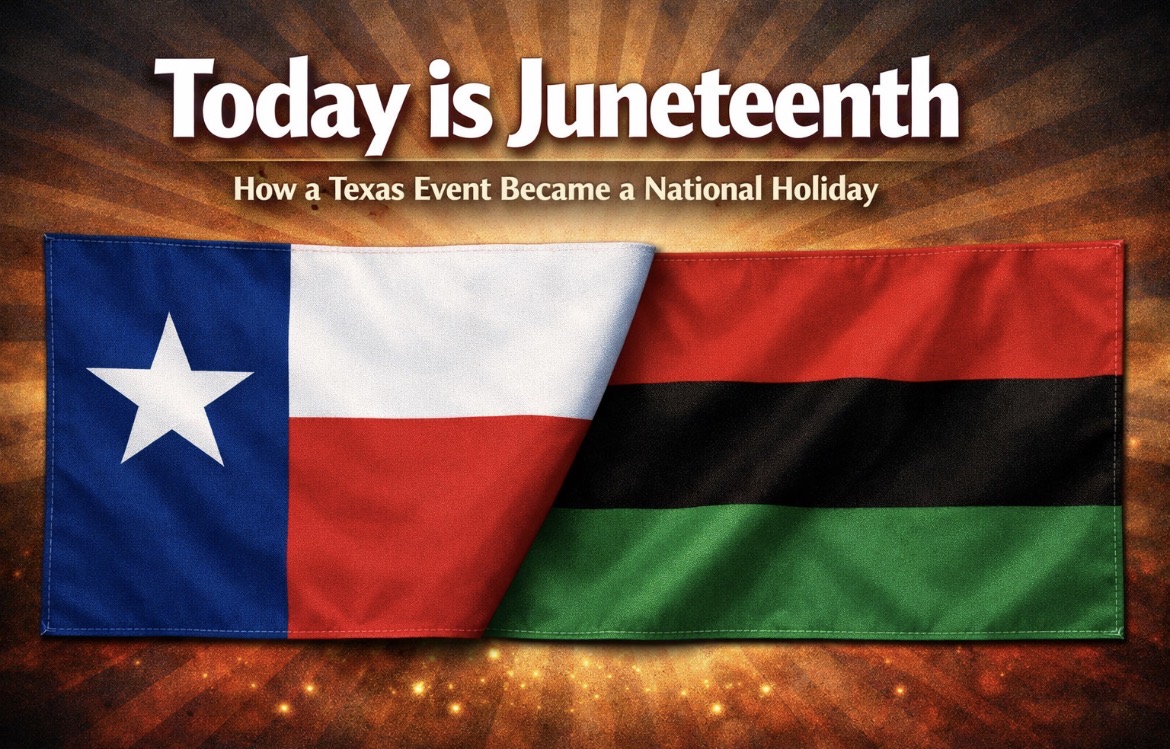
Today is Juneteenth: How a Texas Event Became a National Holiday
By Selina Xia Zamacois
TEXAS — Juneteenth, now a federal holiday, began in Texas and marks the day enslaved people in the state finally learned they were free—more than two years after the Emancipation Proclamation. The observance traces back to June 19, 1865, when Union troops arrived in Galveston and issued General Order No. 3, enforcing the end of slavery in the last Confederate state where emancipation had not been implemented.
According to the Texas State Library and Archives Commission, Major General Gordon Granger’s order informed Texans that “all slaves are free,” formally ending the institution of slavery for an estimated 250,000 enslaved people who had remained in bondage despite President Abraham Lincoln’s 1863 proclamation. The delay was due to the minimal Union military presence in Texas during the Civil War and resistance from enslavers who continued forced labor until federal troops arrived.
Historians at the University of Texas note that the announcement triggered immediate and widespread celebrations among newly freed Black Texans. Many left plantations in what became known as the “Great Migration of 1865,” traveling to reunite with family members or establish new communities across the state.
By 1866, freedmen in Texas began marking June 19 as “Emancipation Day.” Early celebrations included church services, speeches, music, and community gatherings. As segregation limited access to public spaces, Black Texans purchased land specifically for Juneteenth events. One of the most notable examples is Emancipation Park in Houston, acquired in 1872 by four formerly enslaved men and still used today for annual observances.
Juneteenth remained a cornerstone of Black community life in Texas throughout the late 19th and early 20th centuries. The holiday experienced a resurgence during the Civil Rights Movement, and in 1980 Texas became the first state to officially recognize Juneteenth as a state holiday.
The holiday’s national profile continued to grow, and on June 17, 2021, it became the 11th federal holiday in the United States.
Today, Juneteenth is celebrated across Texas with parades, educational programs, historical reenactments, and community festivals. Galveston, the birthplace of the holiday, hosts some of the largest events, including readings of General Order No. 3 at the site where it was first announced.
For many Texans, Juneteenth represents not only the end of slavery in the state but also a broader reflection on freedom, resilience, and the ongoing pursuit of equality.