


Fifth Circuit Rules On Firearm Suppressors
By Selina Xia Zamacois
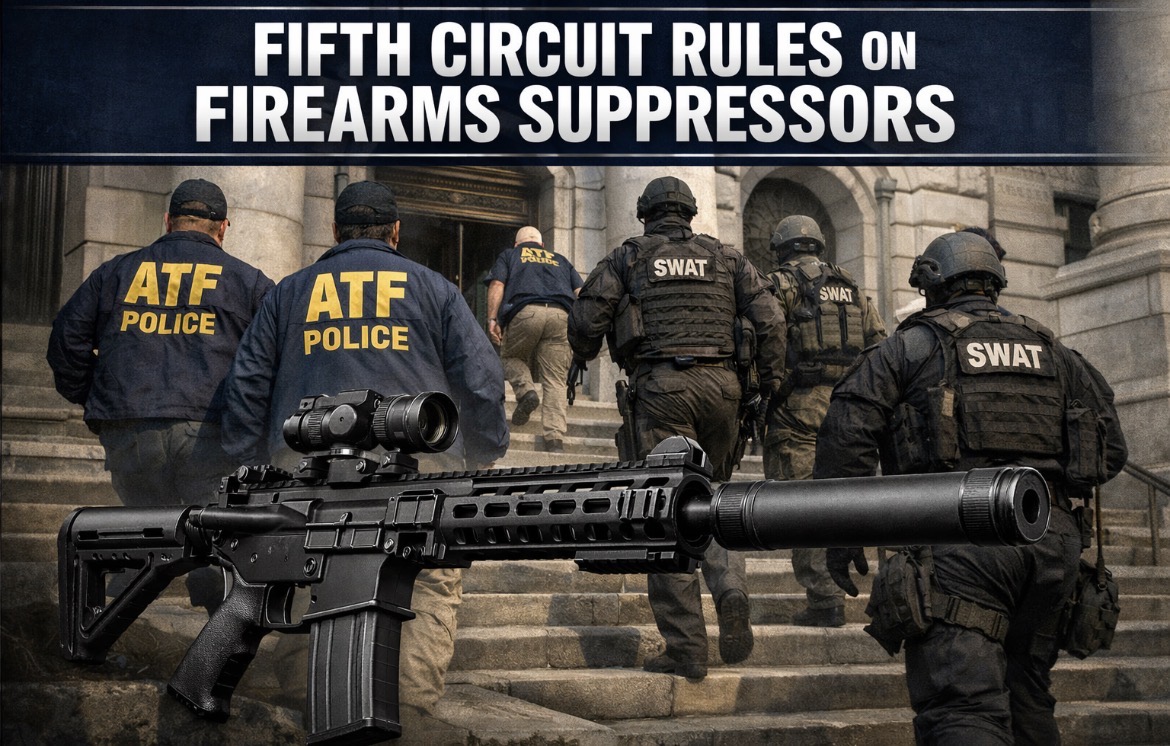
NEW ORLEANS — The U.S. Court of Appeals for the Fifth Circuit ruled that firearm suppressors—commonly known as silencers—are protected “Arms” under the Second Amendment, marking a significant development in ongoing legal battles over federal firearms regulations.
The decision came in United States v. Comeaux, a case involving Brennan James Comeaux of Louisiana, who was charged with possessing unregistered suppressors in violation of the National Firearms Act (NFA). Comeaux argued that the NFA’s registration requirement for suppressors violates the Second Amendment both on its face and as applied to him.
Writing for the panel, Judge Jerry E. Smith concluded that suppressors meet the constitutional definition of “Arms” because they serve “critical functions that make firearms both safer and more effective for their core lawful purpose of self-defense.” The opinion cites benefits such as reduced noise, lower recoil, and improved accuracy.
However, despite recognizing suppressors as protected “Arms,” the court upheld Comeaux’s conviction.
The panel ruled that under existing Fifth Circuit precedent—specifically United States v. Peterson (2025)—a defendant must show that the NFA’s registration system has been applied in an abusive or prohibitive manner, such as through excessive fees or unreasonable delays. Comeaux made no such claim.
Because he did not attempt to register the suppressors or argue that the system prevented him from doing so, the court held that his Second Amendment challenge failed at the first step of the Bruen analysis.
The Fifth Circuit emphasized that it was bound by Peterson, which held that the NFA’s “shall‑issue” registration process for suppressors is “presumptively lawful” unless a challenger can show the system has been misused.
The court noted that Peterson left open the possibility of a successful future challenge but found that Comeaux’s case did not provide the necessary factual basis.
Judge Edith Brown Clement, joined by Judge Stuart Kyle Duncan, agreed with the outcome but wrote separately to criticize Peterson. She argued that the earlier decision misread the Supreme Court’s Bruen ruling by creating an improper “presumption of constitutionality” for licensing systems.
Clement urged the full Fifth Circuit to revisit Peterson, writing that the current framework “traded history for dictum” and improperly inserted a “half‑step” into the Bruen test that shields the NFA from full historical scrutiny.
Bottom Line
- The Fifth Circuit officially recognizes suppressors as Second Amendment–protected “Arms.”
- Despite that recognition, the court upheld the federal ban on possessing unregistered suppressors, because the defendant did not show the NFA’s registration system was applied abusively.
- A concurring judge signaled that the court’s precedent may be ripe for reconsideration in a future case.