


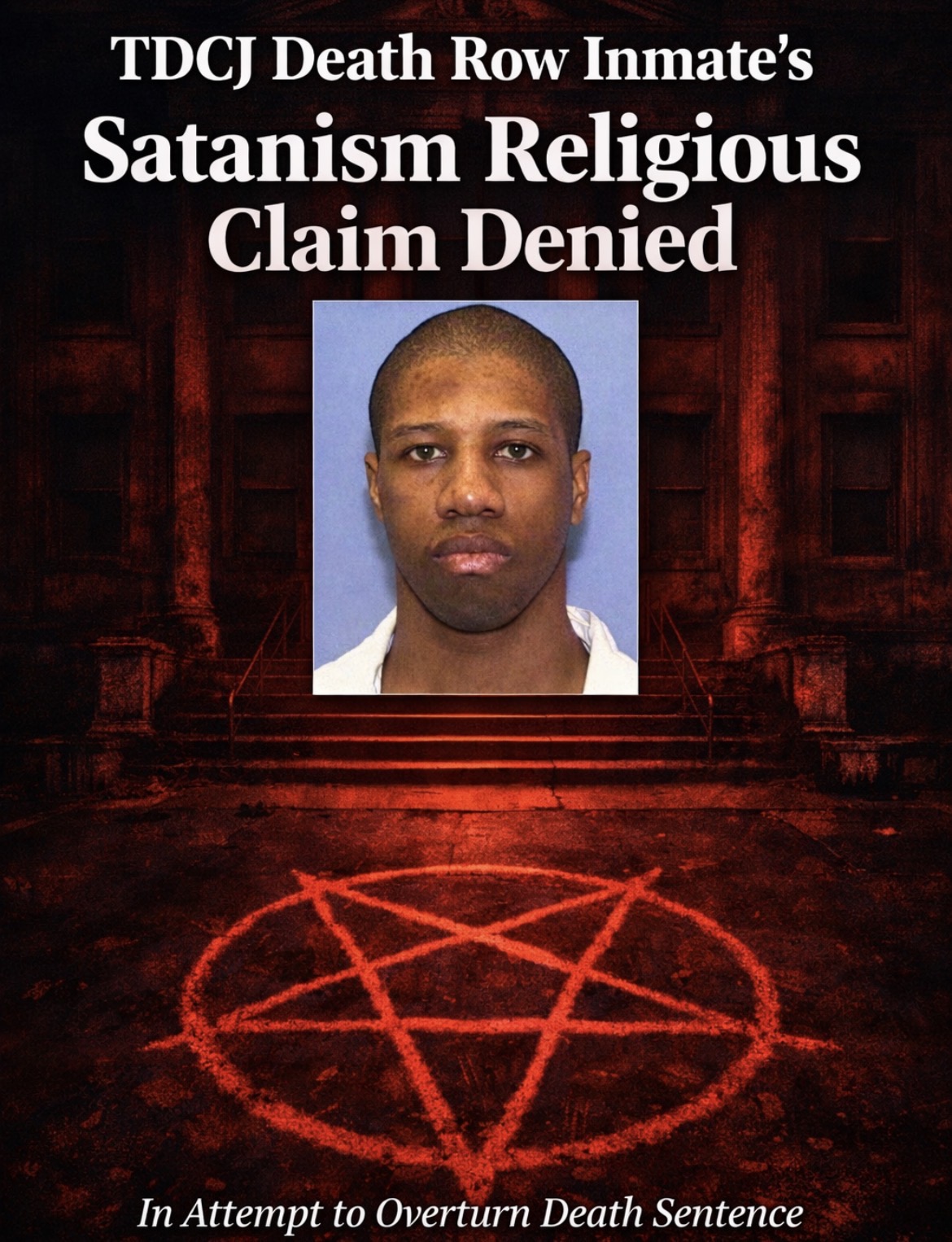
TDCJ Death Row Inmate’s Satanism Religious Claim Denied In Attempt to Overturn Death Sentence
By Selina Xia Zamacois
NEW ORLEANS, LA — The U.S. Court of Appeals for the Fifth Circuit has upheld a lower court’s decision denying federal habeas corpus relief to Irving Alvin Davis, a Texas inmate sentenced to death for the 1998 rape and murder of 15‑year‑old Melissa Medina in El Paso.
The ruling, issued July 3, found that Davis failed to show any constitutional error that would justify overturning the state court’s judgment.
Medina’s body was discovered in the parking lot of an elementary school. Court records describe severe blunt‑force injuries, internal trauma, and evidence of sexual assault. Davis was convicted of capital murder in 2002.
The Texas Court of Criminal Appeals later ordered a new punishment hearing, and in 2008 Davis was again sentenced to death. During that resentencing, prosecutors introduced Davis’s drawings, writings, and statements referencing Satanism to argue he posed a future danger to society, a required finding for a death sentence in Texas.
Davis challenged the use of that evidence, arguing it violated his First Amendment rights. He also claimed his attorneys were ineffective for failing to properly challenge the material and for other alleged errors. After state courts rejected those arguments, Davis sought relief in federal court.
Under the Antiterrorism and Effective Death Penalty Act (AEDPA), federal courts must defer to state court decisions unless they are contrary to clearly established federal law or based on unreasonable factual determinations. The Fifth Circuit concluded Davis did not meet that standard.
Key points from the ruling:
- First Amendment Claim: The court agreed with the Texas Court of Criminal Appeals that the evidence related to Davis’s Satanism was used to demonstrate future dangerousness, not to punish him for protected religious or expressive beliefs. Because the state court applied established Supreme Court precedent, the Fifth Circuit found no constitutional violation.
- Ineffective Assistance of Counsel: The appellate court held that Davis failed to show his attorneys’ performance was deficient or that any alleged errors affected the outcome. The state habeas court’s findings were entitled to deference.
- AEDPA Deference: The opinion emphasized that federal habeas review is “highly deferential” and that Davis did not demonstrate that the state courts acted unreasonably in rejecting his claims.
The Fifth Circuit affirmed the district court’s judgment, leaving Davis’s death sentence in place. The ruling closes another avenue of federal review and underscores the narrow path available for inmates seeking to overturn state convictions through habeas corpus.