



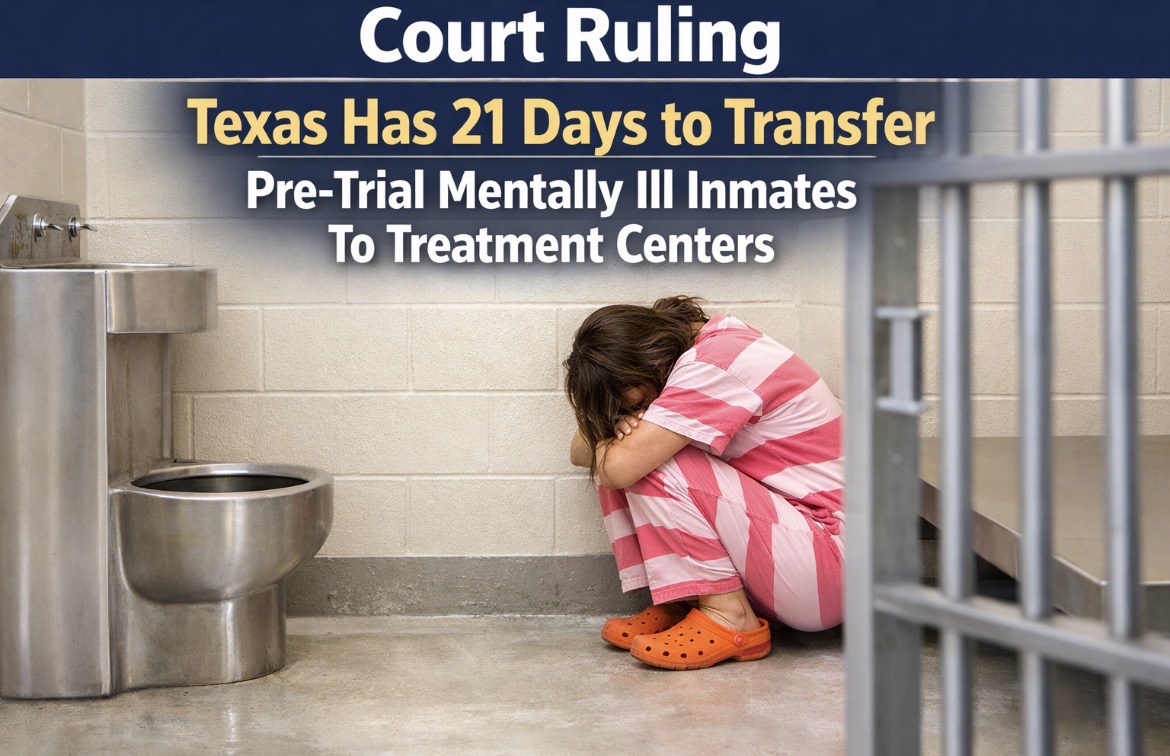
Court Orders Texas To Tranfer Pre-Trial Mentally Ill Inmates To Treatment Centers Within 21 Days
By Selina Xia Zamacois
AUSTIN — A federal judge has issued a detailed, 117‑page ruling finding that the Texas Health and Human Services Commission (HHSC) has for years violated the constitutional rights of criminal defendants who were found incompetent to stand trial but left waiting in county jails—often for months—without the court‑ordered mental‑health treatment required to restore their competency.
The ruling, released July 7, 2026, in Ward v. Muth, concludes a decade‑long class‑action lawsuit brought on behalf of thousands of Texans who remain jailed more than 21 days after HHSC receives a court order committing them to a state mental health facility. The court found that HHSC’s chronic lack of forensic psychiatric beds has created unlawful delays that violate the substantive due‑process protections of the Fourteenth Amendment.
“This case is a class action seeking declaratory and injunctive relief… to compel [HHSC] to timely admit class members to state mental health facilities for competency restoration treatment after they have been found incompetent to stand trial,” the ruling states.
The court found that every named plaintiff—including Joseph Ward, Marc Lawson, Jennifer Lampkin, Kenneth Jones, and Julian Torres—was held in jail far beyond the 21‑day statutory window. In one example, Ward waited more than a year before being transferred to a state hospital.
“Each Named Plaintiff… was confined in jail more than 21 days after HHSC received the orders committing them… before they began to receive those services.”
The judge emphasized that HHSC alone is responsible for admitting defendants into competency restoration programs and operating the facilities that provide those services.
HHSC “shall plan… for the proper and separate allocation of beds… for patients… committed… to attain competency to stand trial.”
The ruling details how Texas law offers only three pathways for competency restoration—outpatient programs, jail‑based programs, or inpatient state facilities—but most defendants are ineligible for the first two. Outpatient programs exist in fewer than 25% of counties, and jail‑based programs serve only a fraction of detainees.
As a result, the court found, “the vast majority” of incompetent defendants must rely on HHSC‑run inpatient facilities, where bed shortages have created long waitlists.
The judge reaffirmed that the governing legal standard is the U.S. Supreme Court’s decision in Jackson v. Indiana (1972), which prohibits states from holding incompetent defendants indefinitely without timely restoration services.
The court previously rejected HHSC’s argument that the delays should be judged under a more lenient “rational basis”
In an unusual move, Governor Greg Abbott filed an amicus brief nearly ten years into the litigation, arguing that the Prison Litigation Reform Act (PLRA) should govern the case and limit the court’s ability to order relief.
The judge accepted the filing but noted its lateness and addressed the PLRA arguments separately in the ruling.
The ruling sets the stage for potential court‑ordered remedies requiring HHSC to expand forensic psychiatric capacity, reduce wait times, and comply with statutory deadlines for admitting incompetent defendants.
The court has not yet issued its final injunction, but the findings signal that major operational changes may soon be mandated for Texas’s mental‑health and criminal‑justice systems.